✨ New Arrivals Just Dropped!Explore
\n\n \n \n \n\n \n\n\n
\n\n \n
\n

Arccaptain Accessories

\n

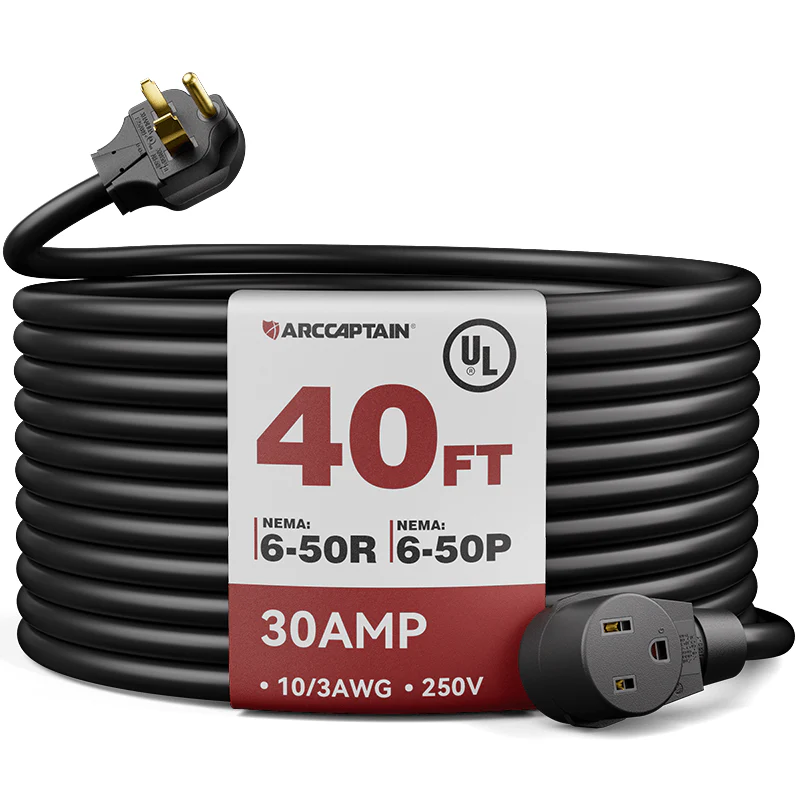
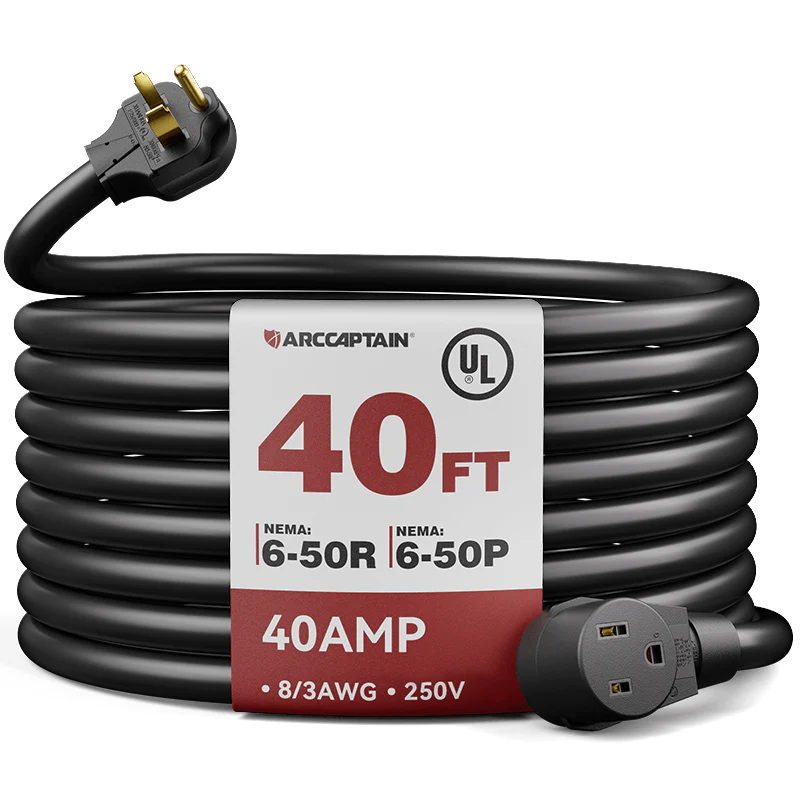
NEMA 6-50 Welder Extension Cord

\n\n
\n
\n
6 Configurations — 2 Gauges × 3 Lengths
\n
The Power Your Welder Gets Is Only
as Good as the Cord Delivering It
\n

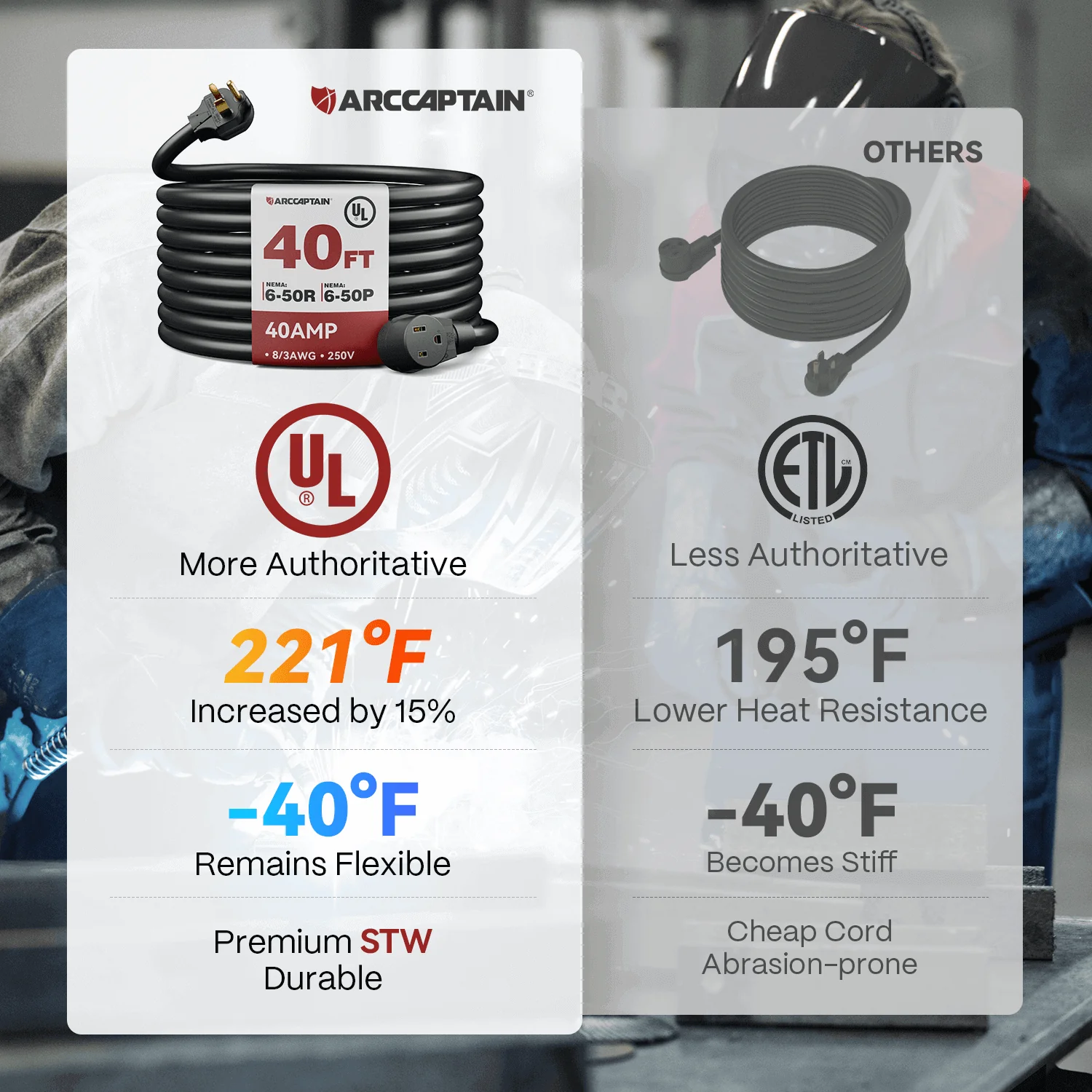
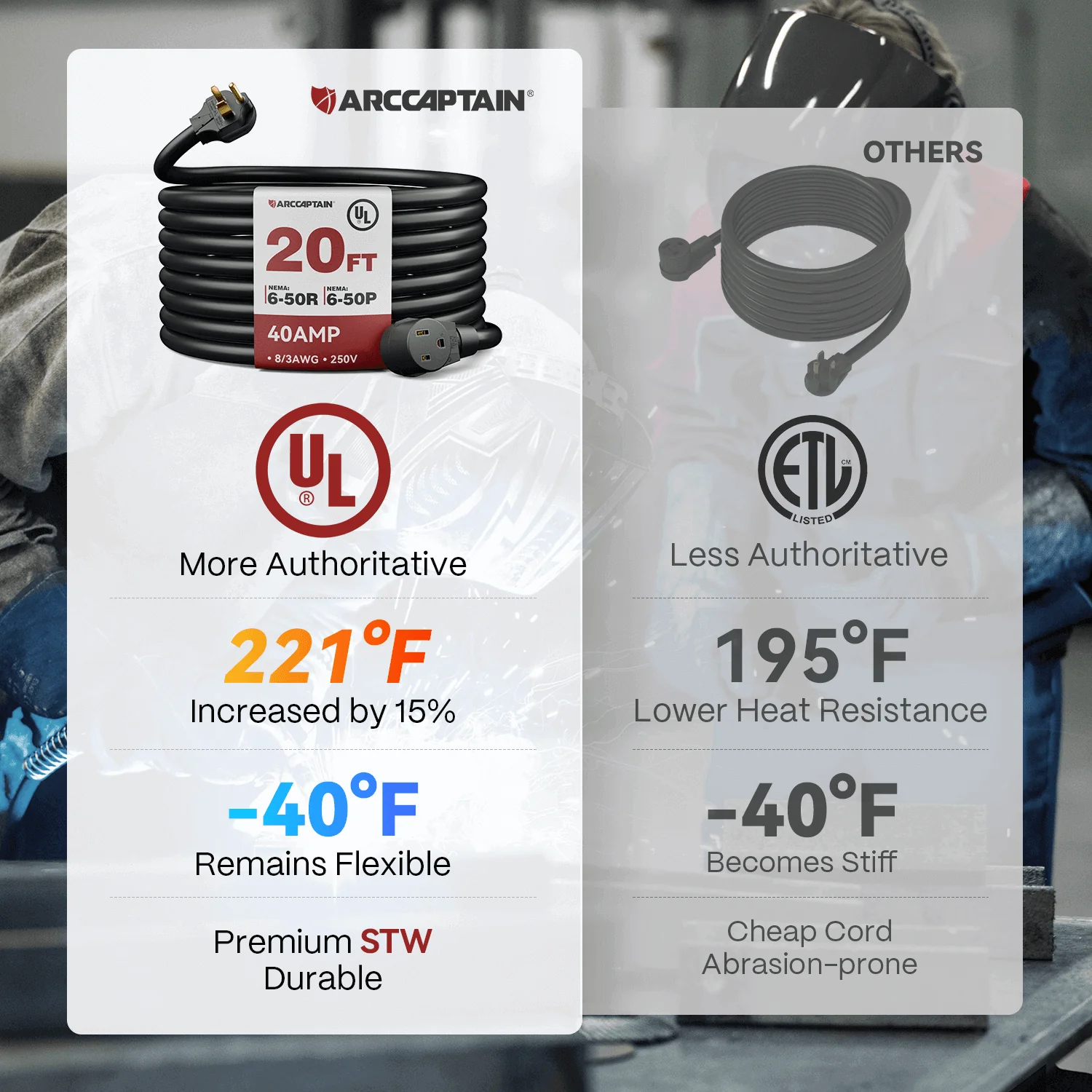
A welder set to 220V and 150A is only running at those numbers if the extension cord between the outlet and the machine can carry that current without resistance loss. The wrong gauge or the wrong length introduces voltage drop that degrades arc stability, reduces effective duty cycle, and trips breakers — and the symptoms show up as welder problems when the cord is the actual cause.

\n
\n
\n
\n
6
\n
Configurations
\n
\n
\n
2
\n
Gauges: 8 & 10 AWG
\n
\n
\n
3
\n
Lengths: 20 / 40 / 50ft
\n
\n
\n
40A
\n
Max Rated (8AWG)
\n
\n
\n
\n
\n\n \n
\n

How to Choose

\n

Pick Your Configuration in Three Steps

\n\n
\n
\n
1
\n
Find Your Machine in the Compatibility Tables
\n

Look up your Arccaptain model and your operating voltage (110V or 220V) in the tables in Section 4. This tells you the minimum recommended AWG for your specific combination. That number — 8 or 10 — is your gauge.

\n
\n
\n
2
\n
Measure Your Installation Distance
\n

Measure from your wall outlet to the farthest point your welder will be positioned — plus a few feet of slack. If your measurement is under 20ft, choose 20ft. Under 40ft, choose 40ft. Up to 50ft, choose 50ft. Never go shorter than your actual run distance — a cord under tension at connections is a failure point.

\n
\n
\n
3
\n
When in Doubt, Go Heavier
\n

If your measurement puts you between lengths or you're unsure about gauge, size up on both. 8AWG/50ft handles every machine in the Arccaptain lineup at both voltages. It is the universal safe choice — heavier wire than necessary causes no harm; lighter wire than necessary causes real problems.

\n
\n
\n
\n\n \n
\n

All Six Options

\n

Gauge by Length — Choose Your Combination

\n

Each row represents one gauge family. Within each gauge, three length options cover short, medium, and long installation runs.

\n\n
\n \n
\n
\n
10 AWG
\n
30A  ·  Light to Mid
\n
\n
\n
\n
20ft (6m)
\n

Home garage, short runs, low-power welders. Best performance at this gauge and length combination.

\n
\n
\n
40ft (12m)
\n

Occasional machine repositioning. Only for machines whose draw is comfortably within 30A at the operating voltage.

\n
\n
\n
50ft (15m)
\n

Extended home-use reach. Highest voltage drop of any configuration — only for light-duty machines at 220V/240V where draw is low.

\n
\n
\n
\n\n \n
\n
\n
8 AWG
\n
40A  ·  Mid to High
\n
\n
\n
\n
20ft (6m)
\n

Fixed shop outlets near the work area. Minimum voltage drop, maximum stable performance for professional machines.

\n
\n
\n
40ft (12m)
\n

Workshops, garages, construction sites with frequent machine movement. The most versatile 8AWG configuration.

\n
\n
\n
50ft (15m)
\n

Large shops, farms, job sites. Full-power delivery at distance — 8AWG keeps voltage drop acceptable even at 50ft under load.

\n
\n
\n
\n
\n\n \n

Quick Decision Matrix

\n
\n
\n
Your Situation
\n
Recommended Gauge
\n
Recommended Length
\n
\n
\n
\n
Home garage, light machine, short run
\n
10 AWG
\n
20ft
\n
\n
\n
Home garage, light machine, needs reach
\n
10 AWG
\n
40ft or 50ft
\n
\n
\n
Mid-power machine, fixed outlet location
\n
8 AWG
\n
20ft
\n
\n
\n
Mid-power machine, frequent repositioning
\n
8 AWG
\n
40ft
\n
\n
\n
High-power machine, any distance
\n
8 AWG
\n
Match your run distance
\n
\n
\n
Large shop, farm, or job site, maximum reach
\n
8 AWG
\n
50ft
\n
\n
\n
Unsure — want the universal safe option
\n
8 AWG
\n
40ft or 50ft
\n
\n
\n
\n
\n\n \n
\n

Machine Compatibility Guide

\n

Recommended Gauge by Model and Voltage

\n

Find your Arccaptain machine below. The recommended gauge is the minimum for that model at that voltage. Use this gauge at any length — if you're running 50ft with a machine that recommends 8AWG, always use 8AWG regardless of length.

\n\n
\n\n
\n
\n
\n
\n Plasma Cutters\n CUT Series\n
\n
\n
\n \n \n \n \n \n \n \n \n \n \n\n\n \n\n\n \n\n\n \n\n\n \n\n\n \n\n\n \n
Model110V / 120V220V / 240V
CUT50 8 AWG 10 AWG
CUT55 LED 8 AWG 10 AWG
CUT55 Pro 8 AWG 10 AWG
CUT55 Prolux 8 AWG 8 AWG
CUT55 NON-HF 8 AWG 8 AWG
CUT55 MP 8 AWG 8 AWG
\n
\n
\n\n
\n
\n
\n
\n MIG Welders\n MIG Series\n
\n
\n
\n \n \n \n \n \n \n \n \n \n \n\n\n \n\n\n \n\n\n \n\n\n \n\n\n \n\n\n \n\n\n \n\n\n \n
Model110V / 120V220V / 240V
MIG145 Pro 8 AWG
MIG160 8 AWG 10 AWG
MIG165 8 AWG 10 AWG
MIG165 Pro 10 AWG
MIG200 8 AWG 10 AWG
MIG200 Fit 8 AWG 10 AWG
MIG250 8 AWG
MIG205 MP 8 AWG 8 AWG
\n
\n
\n\n
\n
\n
\n
\n TIG Welders\n TIG Series\n
\n
\n
\n \n \n \n \n \n \n \n \n \n \n\n\n \n\n\n \n\n\n \n\n\n \n
Model110V / 120V220V / 240V
TIG200 8 AWG 8 AWG
TIG200P AC DC 8 AWG 10 AWG
TIG205 Pro 8 AWG 10 AWG
TIG205P Pro 8 AWG 10 AWG
\n
\n
\n\n
\n
\n
\n
\n ARC / Stick Welders\n ARC Series\n
\n
\n
\n \n \n \n \n \n \n \n \n \n \n\n\n \n\n\n \n\n\n \n\n\n \n
Model110V / 120V220V / 240V
ARC160 10 AWG 10 AWG
ARC200 8 AWG 8 AWG
ARC165 Pro 10 AWG 10 AWG
ARC205 Pro 8 AWG 8 AWG
\n
\n
\n\n
\n\n

Reading these tables: Red = 8 AWG required. Dark = 10 AWG sufficient. Dash = that voltage is not supported by this model. When your machine shows different gauges for 110V vs 220V and you run both voltages, always buy 8AWG — it covers both without compromise.

\n
\n\n \n
\n

What Goes Wrong

\n

Four Real Consequences of the Wrong Cord

\n

The effects of an undersized extension cord are consistent and predictable. They're also frequently blamed on the welder itself — which makes them worth knowing in advance.

\n\n
\n
\n
Voltage Drop at the Machine
\n
Every foot of wire has resistance proportional to its cross-section. At 50ft with 10AWG under a 30A load, voltage at the machine's input can be 4–8V below the outlet voltage — enough to alter arc characteristics, reduce output, and cause inconsistency that looks like a welder tuning issue. It isn't. It's cord resistance.
\n
\n
\n
Nuisance Breaker Tripping
\n
Voltage drop caused by an undersized cord causes the machine to draw more current to compensate — which can push the circuit above the breaker threshold. Repeated mid-weld trips are a consistent sign of an undersized cord, not a tripped GFCI or a faulty breaker. Upgrading to 8AWG resolves this in most cases.
\n
\n
\n
Wire and Connector Overheating
\n
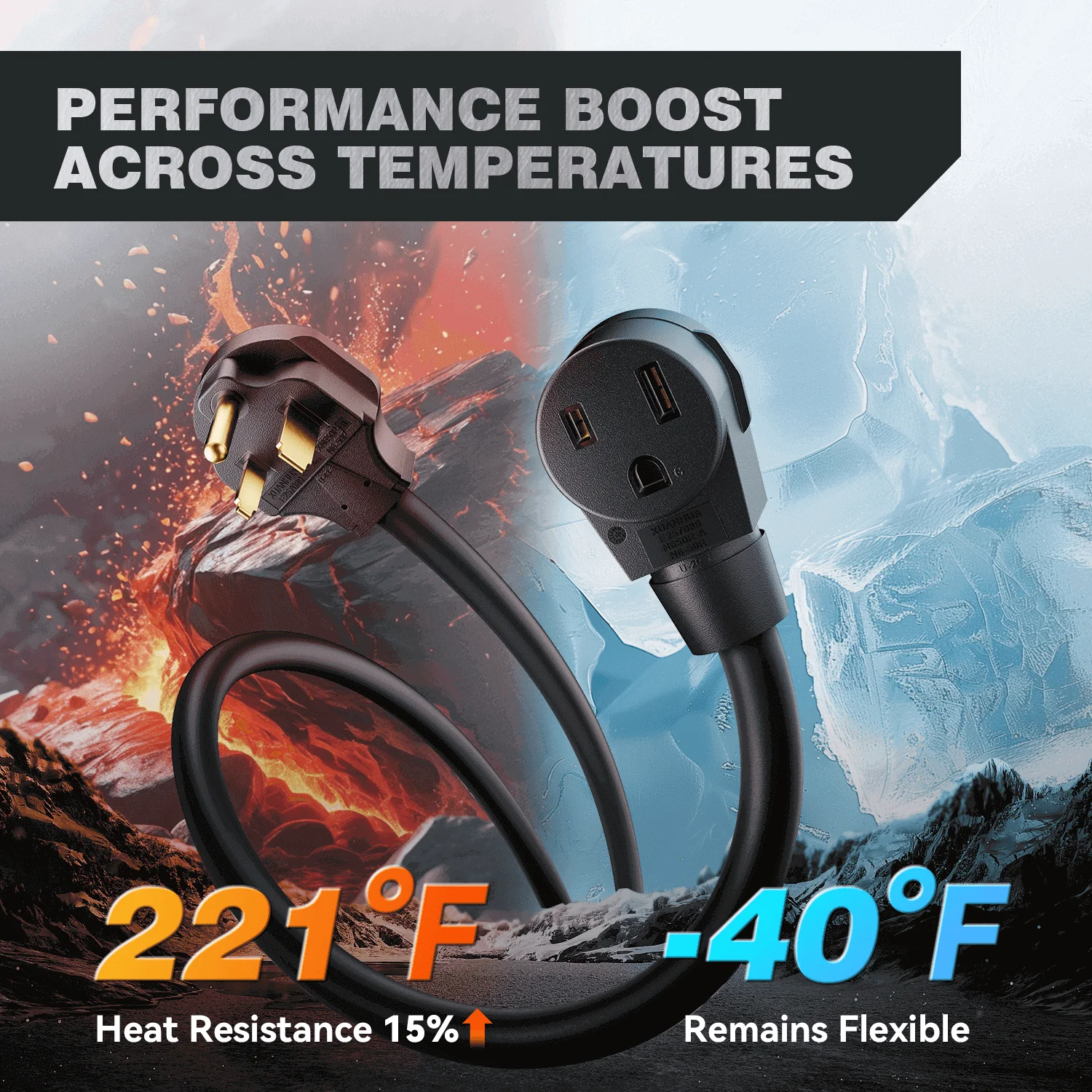
Sustained current above a cord's rating generates heat — in the wire and, critically, at plug and socket connections. Heat degrades insulation progressively and creates risk at connection points over time. The degradation is gradual and invisible externally until the cord fails.
\n
\n
\n
Reduced Duty Cycle
\n
A welder's stated duty cycle assumes it's receiving its rated input voltage. Voltage drop from an undersized cord means the machine is running at reduced effective power — it works harder to produce the same output, generates more internal heat, and reaches its thermal protection threshold faster. The duty cycle you see in practice is lower than the spec sheet shows.
\n
\n
\n
\n\n \n
\n

Complete Specifications

\n

All Six Configurations — Full Specs

\n\n
\n \n \n \n \n \n \n \n \n \n \n \n \n \n \n \n \n \n \n \n \n \n \n \n \n \n \n \n \n \n \n \n \n \n \n \n \n \n \n \n \n \n \n \n \n \n \n \n \n \n \n \n \n \n \n
ConfigurationGaugeLengthRated CurrentBest For
10AWG / 20ft10AWG20ft (6m)30ALow-power welders, short home garage or shop runs at 110V or 220V
10AWG / 40ft10AWG40ft (12m)30AOccasional repositioning for home users; not for sustained high-power operation
10AWG / 50ft10AWG50ft (15m)30AExtended reach for light-duty machines only; not suitable for high-power welders at this length
8AWG / 20ft8AWG20ft (6m)40AMid- to high-power welders at short distances — minimum voltage drop, maximum stability
8AWG / 40ft8AWG40ft (12m)40AWorkshops, construction sites, farms — frequent machine movement without current capacity sacrifice
8AWG / 50ft8AWG50ft (15m)40AMaximum reach for high-power machines — stable, full-rated performance over long distances
\n
\n\n

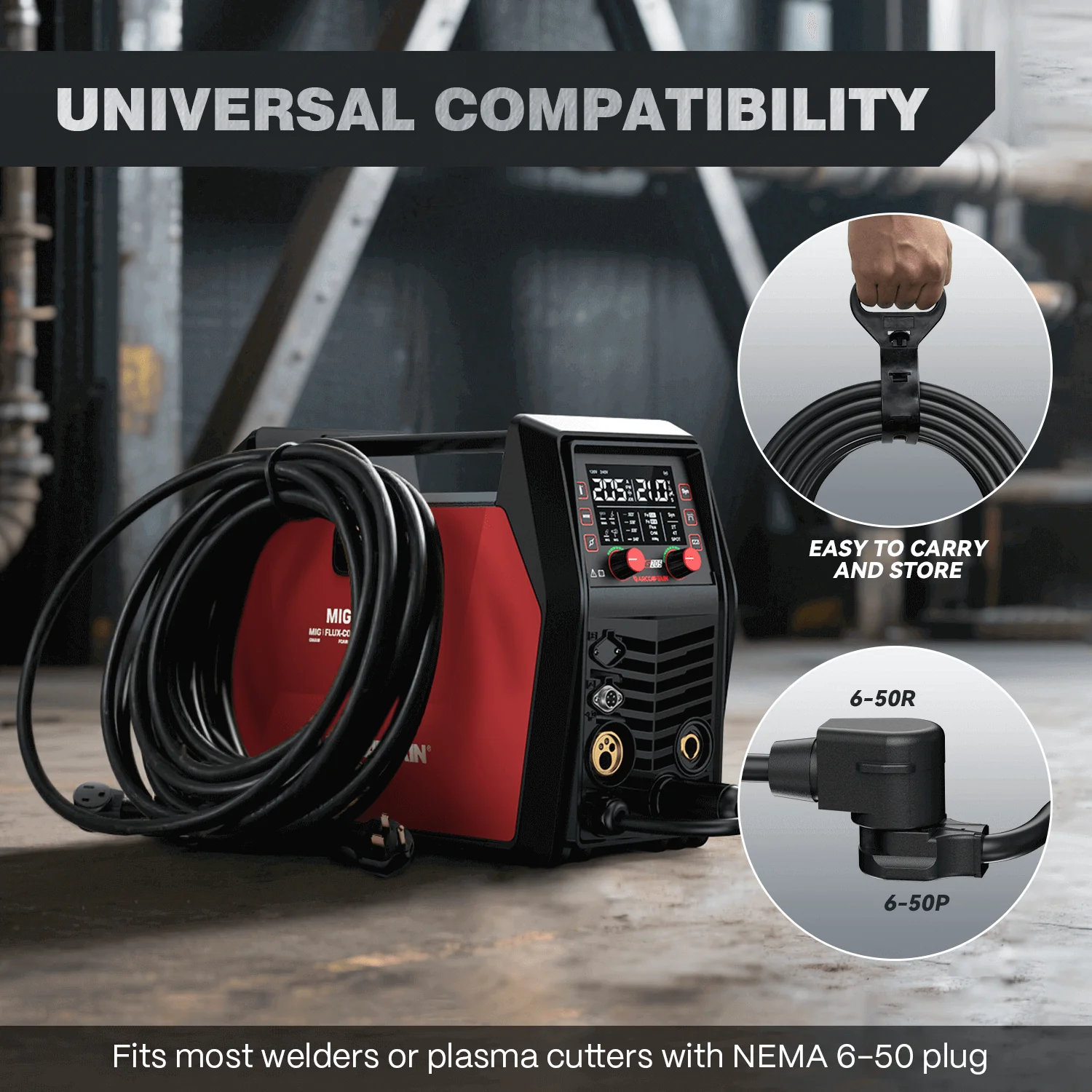
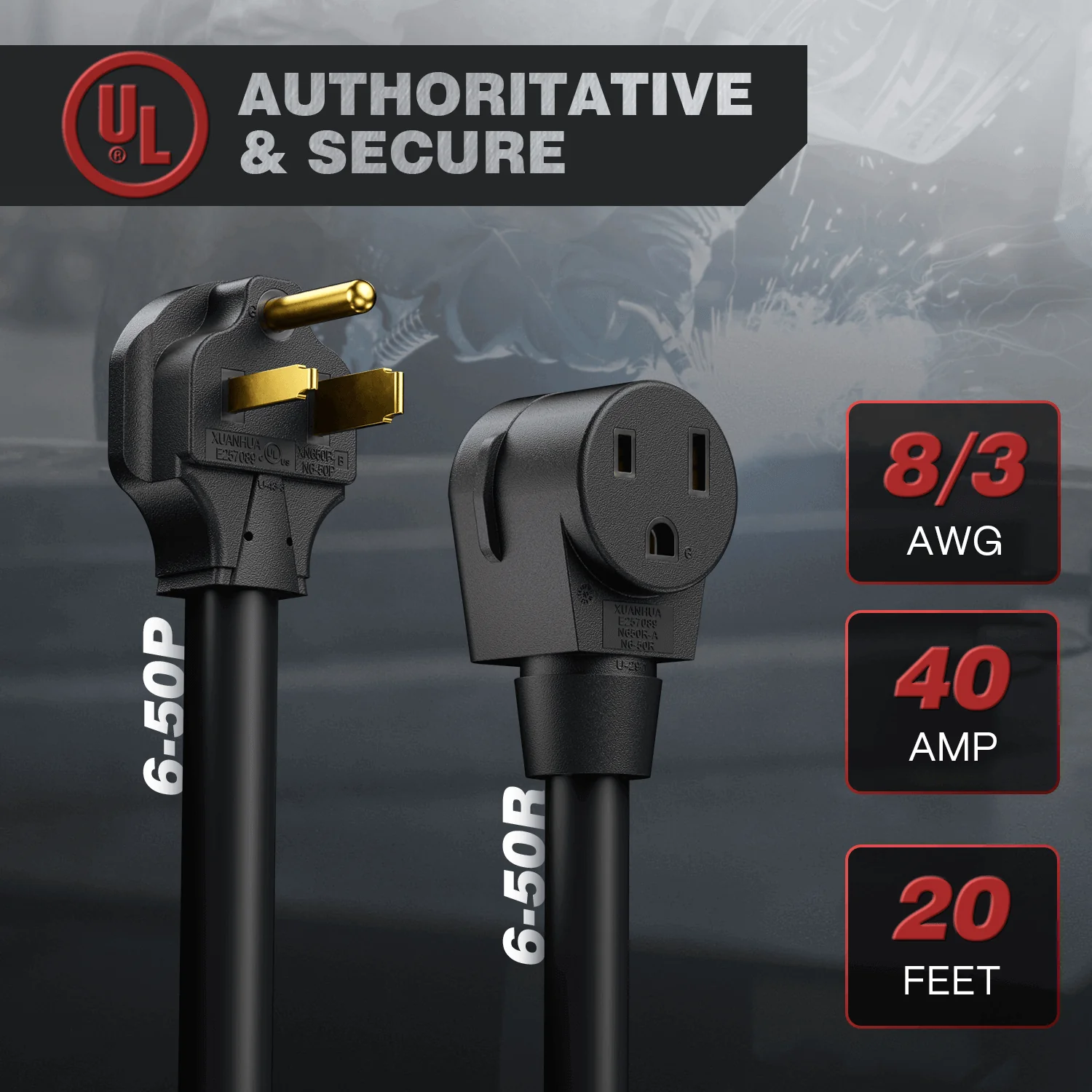
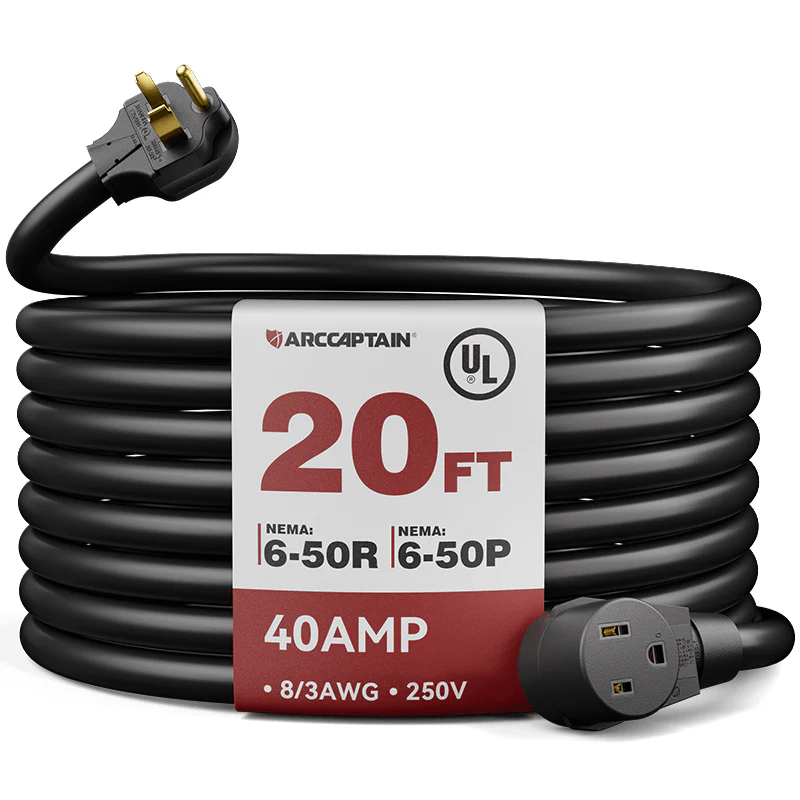
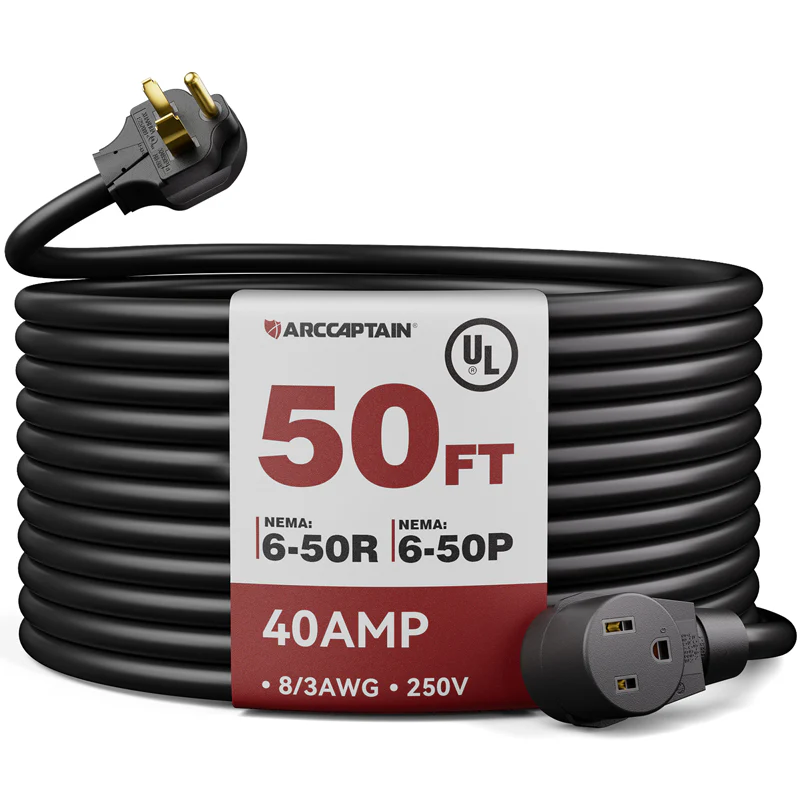
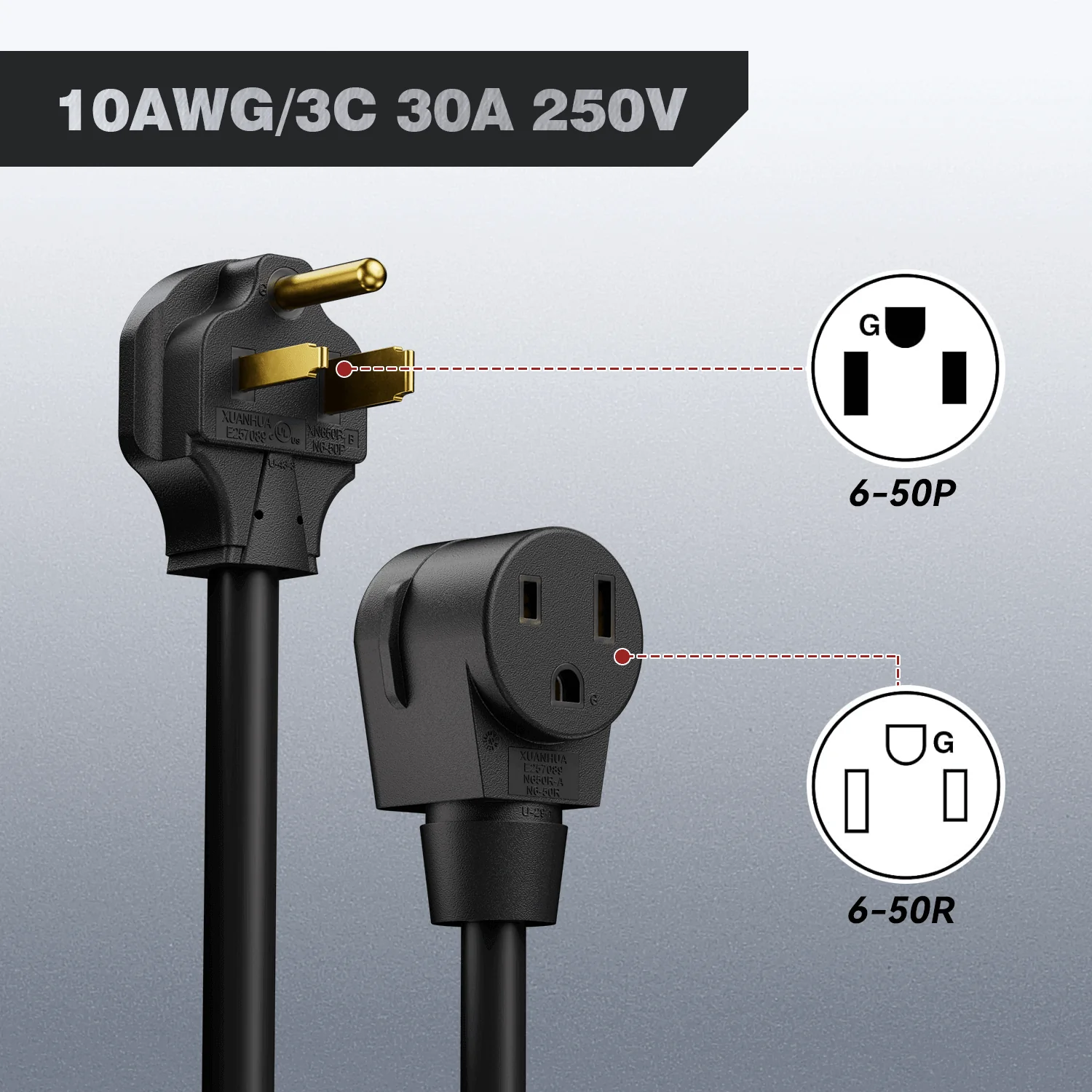
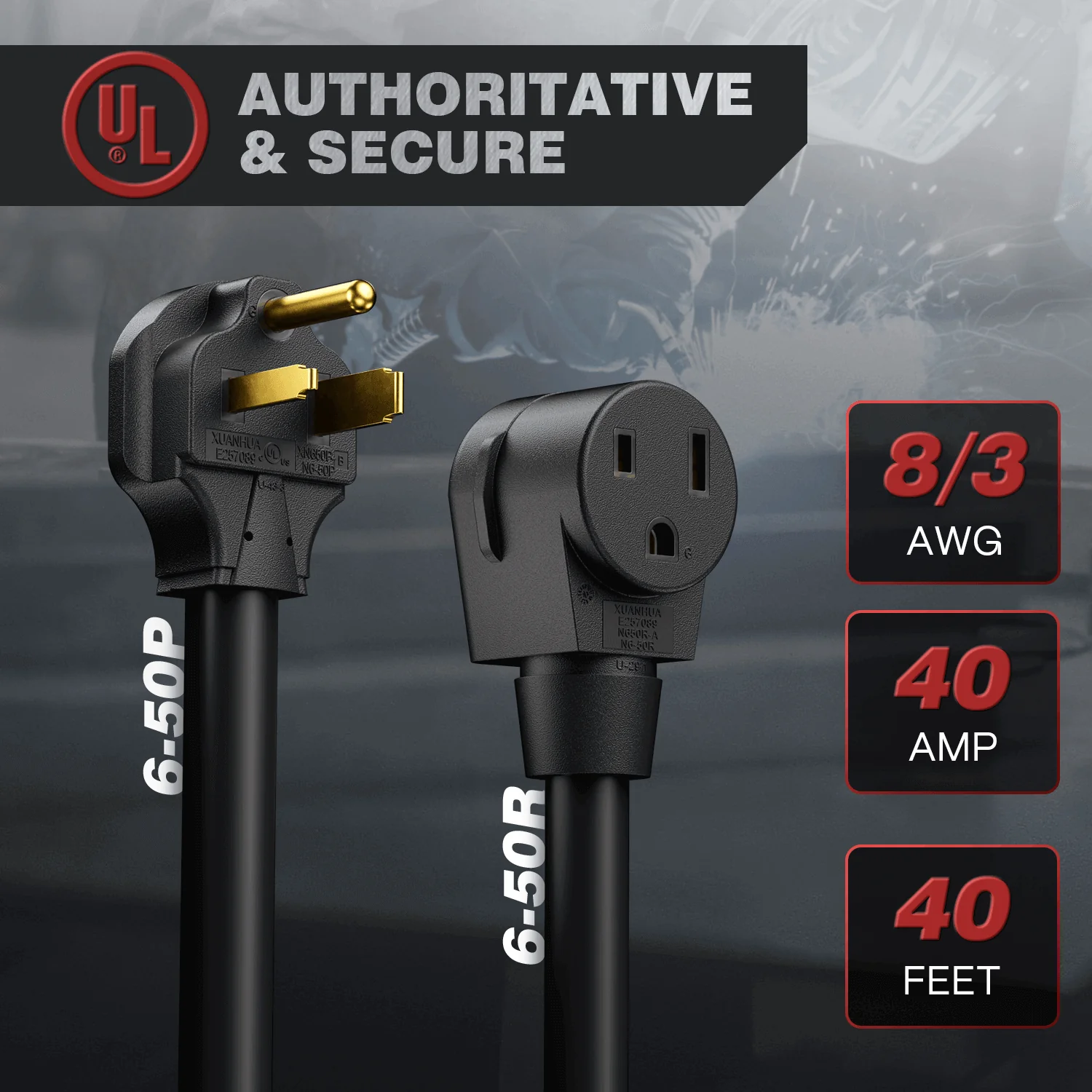
Outlet type reminder: These cords use a NEMA 6-50 plug — the standard 240V / 50A receptacle for welders in North America. Verify your wall outlet is NEMA 6-50 before ordering. NEMA 6-30 (30A) and NEMA 14-50 (four-prong) outlets will not accept this plug. A licensed electrician can install a NEMA 6-50 receptacle if your panel supports a dedicated 50A circuit.

\n
\n\n
\n\n","image":["/images/arccaptainhq.shop/images/product/8-gauge-40-amps-welding-extension-cord-1.png","/images/arccaptainhq.shop/images/product/8-gauge-40-amps-welding-extension-cord-2.png","/images/arccaptainhq.shop/images/product/8-gauge-40-amps-welding-extension-cord-3.png","/images/arccaptainhq.shop/images/product/8-gauge-40-amps-welding-extension-cord-4.png","/images/arccaptainhq.shop/images/product/8-gauge-40-amps-welding-extension-cord-5.png","/images/arccaptainhq.shop/images/product/8-gauge-40-amps-welding-extension-cord-6.png","/images/arccaptainhq.shop/images/product/8-gauge-40-amps-welding-extension-cord-7.png","/images/arccaptainhq.shop/images/product/8-gauge-40-amps-welding-extension-cord-8.png","/images/arccaptainhq.shop/images/product/8-gauge-40-amps-welding-extension-cord-9.png","/images/arccaptainhq.shop/images/product/8-gauge-40-amps-welding-extension-cord-10.jpg"],"sku":"8-gauge-40-amps-welding-extension-cord","brand":{"@type":"Brand","name":"Arccaptain"},"offers":{"@type":"AggregateOffer","lowPrice":72.99,"highPrice":139.99,"priceCurrency":"USD","availability":"https://schema.org/InStock","url":"https://arccaptainhq.shop/products/8-gauge-40-amps-welding-extension-cord","offerCount":3}}
HomeStore

40 Amps 220V Power Extension Cord Heavy Duty Welding Cord

Product image 1
Product image 2
Product image 3
Product image 4
Product image 5
Product image 6
Product image 7
Product image 8
Product image 9
Product image 10

40 Amps 220V Power Extension Cord Heavy Duty Welding Cord

NEMA 6-50 Welder Extension Cord | 8AWG & 10AWG | 20ft 40ft 50ft | Arccaptain

Arccaptain Accessories

NEMA 6-50 Welder Extension Cord

6 Configurations — 2 Gauges × 3 Lengths
The Power Your Welder Gets Is Only
as Good as the Cord Delivering It

A welder set to 220V and 150A is only running at those numbers if the extension cord between the outlet and the machine can carry that current without resistance loss. The wrong gauge or the wrong length introduces voltage drop that degrades arc stability, reduces effective duty cycle, and trips breakers — and the symptoms show up as welder problems when the cord is the actual cause.

6
Configurations
2
Gauges: 8 & 10 AWG
3
Lengths: 20 / 40 / 50ft
40A
Max Rated (8AWG)

How to Choose

Pick Your Configuration in Three Steps

1
Find Your Machine in the Compatibility Tables

Look up your Arccaptain model and your operating voltage (110V or 220V) in the tables in Section 4. This tells you the minimum recommended AWG for your specific combination. That number — 8 or 10 — is your gauge.

2
Measure Your Installation Distance

Measure from your wall outlet to the farthest point your welder will be positioned — plus a few feet of slack. If your measurement is under 20ft, choose 20ft. Under 40ft, choose 40ft. Up to 50ft, choose 50ft. Never go shorter than your actual run distance — a cord under tension at connections is a failure point.

3
When in Doubt, Go Heavier

If your measurement puts you between lengths or you're unsure about gauge, size up on both. 8AWG/50ft handles every machine in the Arccaptain lineup at both voltages. It is the universal safe choice — heavier wire than necessary causes no harm; lighter wire than necessary causes real problems.

All Six Options

Gauge by Length — Choose Your Combination

Each row represents one gauge family. Within each gauge, three length options cover short, medium, and long installation runs.

10 AWG
30A  ·  Light to Mid
20ft (6m)

Home garage, short runs, low-power welders. Best performance at this gauge and length combination.

40ft (12m)

Occasional machine repositioning. Only for machines whose draw is comfortably within 30A at the operating voltage.

50ft (15m)

Extended home-use reach. Highest voltage drop of any configuration — only for light-duty machines at 220V/240V where draw is low.

8 AWG
40A  ·  Mid to High
20ft (6m)

Fixed shop outlets near the work area. Minimum voltage drop, maximum stable performance for professional machines.

40ft (12m)

Workshops, garages, construction sites with frequent machine movement. The most versatile 8AWG configuration.

50ft (15m)

Large shops, farms, job sites. Full-power delivery at distance — 8AWG keeps voltage drop acceptable even at 50ft under load.

Quick Decision Matrix

Your Situation
Recommended Gauge
Recommended Length
Home garage, light machine, short run
10 AWG
20ft
Home garage, light machine, needs reach
10 AWG
40ft or 50ft
Mid-power machine, fixed outlet location
8 AWG
20ft
Mid-power machine, frequent repositioning
8 AWG
40ft
High-power machine, any distance
8 AWG
Match your run distance
Large shop, farm, or job site, maximum reach
8 AWG
50ft
Unsure — want the universal safe option
8 AWG
40ft or 50ft

Machine Compatibility Guide

Recommended Gauge by Model and Voltage

Find your Arccaptain machine below. The recommended gauge is the minimum for that model at that voltage. Use this gauge at any length — if you're running 50ft with a machine that recommends 8AWG, always use 8AWG regardless of length.

Plasma Cutters CUT Series
Model 110V / 120V 220V / 240V
CUT50 8 AWG 10 AWG
CUT55 LED 8 AWG 10 AWG
CUT55 Pro 8 AWG 10 AWG
CUT55 Prolux 8 AWG 8 AWG
CUT55 NON-HF 8 AWG 8 AWG
CUT55 MP 8 AWG 8 AWG
MIG Welders MIG Series
Model 110V / 120V 220V / 240V
MIG145 Pro 8 AWG
MIG160 8 AWG 10 AWG
MIG165 8 AWG 10 AWG
MIG165 Pro 10 AWG
MIG200 8 AWG 10 AWG
MIG200 Fit 8 AWG 10 AWG
MIG250 8 AWG
MIG205 MP 8 AWG 8 AWG
TIG Welders TIG Series
Model 110V / 120V 220V / 240V
TIG200 8 AWG 8 AWG
TIG200P AC DC 8 AWG 10 AWG
TIG205 Pro 8 AWG 10 AWG
TIG205P Pro 8 AWG 10 AWG
ARC / Stick Welders ARC Series
Model 110V / 120V 220V / 240V
ARC160 10 AWG 10 AWG
ARC200 8 AWG 8 AWG
ARC165 Pro 10 AWG 10 AWG
ARC205 Pro 8 AWG 8 AWG

Reading these tables: Red = 8 AWG required. Dark = 10 AWG sufficient. Dash = that voltage is not supported by this model. When your machine shows different gauges for 110V vs 220V and you run both voltages, always buy 8AWG — it covers both without compromise.

What Goes Wrong

Four Real Consequences of the Wrong Cord

The effects of an undersized extension cord are consistent and predictable. They're also frequently blamed on the welder itself — which makes them worth knowing in advance.

Voltage Drop at the Machine
Every foot of wire has resistance proportional to its cross-section. At 50ft with 10AWG under a 30A load, voltage at the machine's input can be 4–8V below the outlet voltage — enough to alter arc characteristics, reduce output, and cause inconsistency that looks like a welder tuning issue. It isn't. It's cord resistance.
Nuisance Breaker Tripping
Voltage drop caused by an undersized cord causes the machine to draw more current to compensate — which can push the circuit above the breaker threshold. Repeated mid-weld trips are a consistent sign of an undersized cord, not a tripped GFCI or a faulty breaker. Upgrading to 8AWG resolves this in most cases.
Wire and Connector Overheating
Sustained current above a cord's rating generates heat — in the wire and, critically, at plug and socket connections. Heat degrades insulation progressively and creates risk at connection points over time. The degradation is gradual and invisible externally until the cord fails.
Reduced Duty Cycle
A welder's stated duty cycle assumes it's receiving its rated input voltage. Voltage drop from an undersized cord means the machine is running at reduced effective power — it works harder to produce the same output, generates more internal heat, and reaches its thermal protection threshold faster. The duty cycle you see in practice is lower than the spec sheet shows.

Complete Specifications

All Six Configurations — Full Specs

Configuration Gauge Length Rated Current Best For
10AWG / 20ft 10AWG 20ft (6m) 30A Low-power welders, short home garage or shop runs at 110V or 220V
10AWG / 40ft 10AWG 40ft (12m) 30A Occasional repositioning for home users; not for sustained high-power operation
10AWG / 50ft 10AWG 50ft (15m) 30A Extended reach for light-duty machines only; not suitable for high-power welders at this length
8AWG / 20ft 8AWG 20ft (6m) 40A Mid- to high-power welders at short distances — minimum voltage drop, maximum stability
8AWG / 40ft 8AWG 40ft (12m) 40A Workshops, construction sites, farms — frequent machine movement without current capacity sacrifice
8AWG / 50ft 8AWG 50ft (15m) 40A Maximum reach for high-power machines — stable, full-rated performance over long distances

Outlet type reminder: These cords use a NEMA 6-50 plug — the standard 240V / 50A receptacle for welders in North America. Verify your wall outlet is NEMA 6-50 before ordering. NEMA 6-30 (30A) and NEMA 14-50 (four-prong) outlets will not accept this plug. A licensed electrician can install a NEMA 6-50 receptacle if your panel supports a dedicated 50A circuit.

Select Option
From $72.99
40 Amps 220V Power Extension Cord Heavy Duty Welding Cord
$72.99

Product Information

Shipping & Returns

Description

NEMA 6-50 Welder Extension Cord | 8AWG & 10AWG | 20ft 40ft 50ft | Arccaptain

Arccaptain Accessories

NEMA 6-50 Welder Extension Cord

6 Configurations — 2 Gauges × 3 Lengths
The Power Your Welder Gets Is Only
as Good as the Cord Delivering It

A welder set to 220V and 150A is only running at those numbers if the extension cord between the outlet and the machine can carry that current without resistance loss. The wrong gauge or the wrong length introduces voltage drop that degrades arc stability, reduces effective duty cycle, and trips breakers — and the symptoms show up as welder problems when the cord is the actual cause.

6
Configurations
2
Gauges: 8 & 10 AWG
3
Lengths: 20 / 40 / 50ft
40A
Max Rated (8AWG)

How to Choose

Pick Your Configuration in Three Steps

1
Find Your Machine in the Compatibility Tables

Look up your Arccaptain model and your operating voltage (110V or 220V) in the tables in Section 4. This tells you the minimum recommended AWG for your specific combination. That number — 8 or 10 — is your gauge.

2
Measure Your Installation Distance

Measure from your wall outlet to the farthest point your welder will be positioned — plus a few feet of slack. If your measurement is under 20ft, choose 20ft. Under 40ft, choose 40ft. Up to 50ft, choose 50ft. Never go shorter than your actual run distance — a cord under tension at connections is a failure point.

3
When in Doubt, Go Heavier

If your measurement puts you between lengths or you're unsure about gauge, size up on both. 8AWG/50ft handles every machine in the Arccaptain lineup at both voltages. It is the universal safe choice — heavier wire than necessary causes no harm; lighter wire than necessary causes real problems.

All Six Options

Gauge by Length — Choose Your Combination

Each row represents one gauge family. Within each gauge, three length options cover short, medium, and long installation runs.

10 AWG
30A  ·  Light to Mid
20ft (6m)

Home garage, short runs, low-power welders. Best performance at this gauge and length combination.

40ft (12m)

Occasional machine repositioning. Only for machines whose draw is comfortably within 30A at the operating voltage.

50ft (15m)

Extended home-use reach. Highest voltage drop of any configuration — only for light-duty machines at 220V/240V where draw is low.

8 AWG
40A  ·  Mid to High
20ft (6m)

Fixed shop outlets near the work area. Minimum voltage drop, maximum stable performance for professional machines.

40ft (12m)

Workshops, garages, construction sites with frequent machine movement. The most versatile 8AWG configuration.

50ft (15m)

Large shops, farms, job sites. Full-power delivery at distance — 8AWG keeps voltage drop acceptable even at 50ft under load.

Quick Decision Matrix

Your Situation
Recommended Gauge
Recommended Length
Home garage, light machine, short run
10 AWG
20ft
Home garage, light machine, needs reach
10 AWG
40ft or 50ft
Mid-power machine, fixed outlet location
8 AWG
20ft
Mid-power machine, frequent repositioning
8 AWG
40ft
High-power machine, any distance
8 AWG
Match your run distance
Large shop, farm, or job site, maximum reach
8 AWG
50ft
Unsure — want the universal safe option
8 AWG
40ft or 50ft

Machine Compatibility Guide

Recommended Gauge by Model and Voltage

Find your Arccaptain machine below. The recommended gauge is the minimum for that model at that voltage. Use this gauge at any length — if you're running 50ft with a machine that recommends 8AWG, always use 8AWG regardless of length.

Plasma Cutters CUT Series
Model 110V / 120V 220V / 240V
CUT50 8 AWG 10 AWG
CUT55 LED 8 AWG 10 AWG
CUT55 Pro 8 AWG 10 AWG
CUT55 Prolux 8 AWG 8 AWG
CUT55 NON-HF 8 AWG 8 AWG
CUT55 MP 8 AWG 8 AWG
MIG Welders MIG Series
Model 110V / 120V 220V / 240V
MIG145 Pro 8 AWG
MIG160 8 AWG 10 AWG
MIG165 8 AWG 10 AWG
MIG165 Pro 10 AWG
MIG200 8 AWG 10 AWG
MIG200 Fit 8 AWG 10 AWG
MIG250 8 AWG
MIG205 MP 8 AWG 8 AWG
TIG Welders TIG Series
Model 110V / 120V 220V / 240V
TIG200 8 AWG 8 AWG
TIG200P AC DC 8 AWG 10 AWG
TIG205 Pro 8 AWG 10 AWG
TIG205P Pro 8 AWG 10 AWG
ARC / Stick Welders ARC Series
Model 110V / 120V 220V / 240V
ARC160 10 AWG 10 AWG
ARC200 8 AWG 8 AWG
ARC165 Pro 10 AWG 10 AWG
ARC205 Pro 8 AWG 8 AWG

Reading these tables: Red = 8 AWG required. Dark = 10 AWG sufficient. Dash = that voltage is not supported by this model. When your machine shows different gauges for 110V vs 220V and you run both voltages, always buy 8AWG — it covers both without compromise.

What Goes Wrong

Four Real Consequences of the Wrong Cord

The effects of an undersized extension cord are consistent and predictable. They're also frequently blamed on the welder itself — which makes them worth knowing in advance.

Voltage Drop at the Machine
Every foot of wire has resistance proportional to its cross-section. At 50ft with 10AWG under a 30A load, voltage at the machine's input can be 4–8V below the outlet voltage — enough to alter arc characteristics, reduce output, and cause inconsistency that looks like a welder tuning issue. It isn't. It's cord resistance.
Nuisance Breaker Tripping
Voltage drop caused by an undersized cord causes the machine to draw more current to compensate — which can push the circuit above the breaker threshold. Repeated mid-weld trips are a consistent sign of an undersized cord, not a tripped GFCI or a faulty breaker. Upgrading to 8AWG resolves this in most cases.
Wire and Connector Overheating
Sustained current above a cord's rating generates heat — in the wire and, critically, at plug and socket connections. Heat degrades insulation progressively and creates risk at connection points over time. The degradation is gradual and invisible externally until the cord fails.
Reduced Duty Cycle
A welder's stated duty cycle assumes it's receiving its rated input voltage. Voltage drop from an undersized cord means the machine is running at reduced effective power — it works harder to produce the same output, generates more internal heat, and reaches its thermal protection threshold faster. The duty cycle you see in practice is lower than the spec sheet shows.

Complete Specifications

All Six Configurations — Full Specs

Configuration Gauge Length Rated Current Best For
10AWG / 20ft 10AWG 20ft (6m) 30A Low-power welders, short home garage or shop runs at 110V or 220V
10AWG / 40ft 10AWG 40ft (12m) 30A Occasional repositioning for home users; not for sustained high-power operation
10AWG / 50ft 10AWG 50ft (15m) 30A Extended reach for light-duty machines only; not suitable for high-power welders at this length
8AWG / 20ft 8AWG 20ft (6m) 40A Mid- to high-power welders at short distances — minimum voltage drop, maximum stability
8AWG / 40ft 8AWG 40ft (12m) 40A Workshops, construction sites, farms — frequent machine movement without current capacity sacrifice
8AWG / 50ft 8AWG 50ft (15m) 40A Maximum reach for high-power machines — stable, full-rated performance over long distances

Outlet type reminder: These cords use a NEMA 6-50 plug — the standard 240V / 50A receptacle for welders in North America. Verify your wall outlet is NEMA 6-50 before ordering. NEMA 6-30 (30A) and NEMA 14-50 (four-prong) outlets will not accept this plug. A licensed electrician can install a NEMA 6-50 receptacle if your panel supports a dedicated 50A circuit.

40 Amps 220V Power Extension Cord Heavy Duty Welding Cord | Arccaptain